Is There a “Wait and See” Role in Hyperparathyroidism?
 u
u
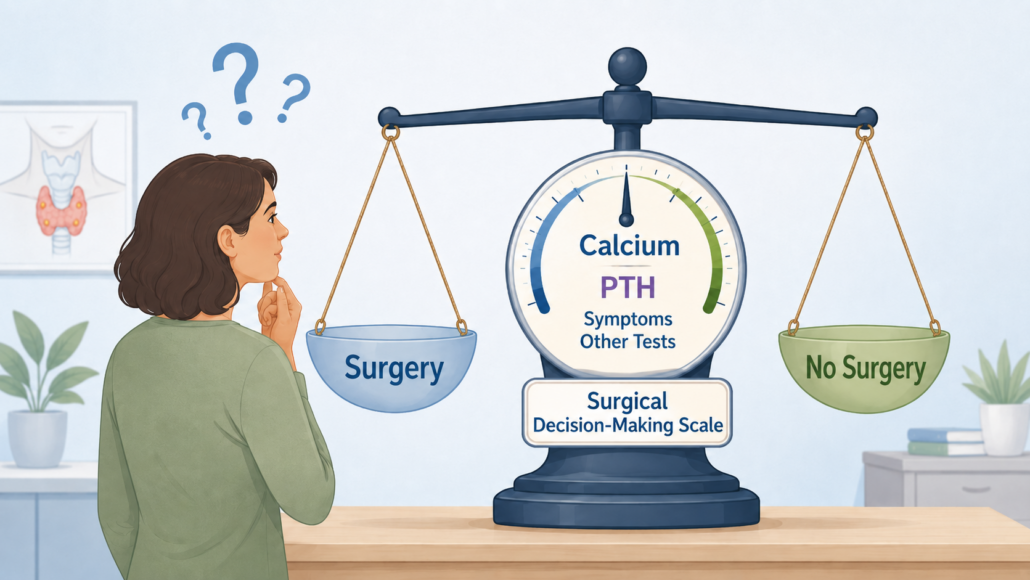
In most patients with primary hyperparathyroidism, surgery is the treatment that should be considered first. It is the only treatment that actually cures the problem. Once the diagnosis is clear, the main question is usually not whether anything should be done, but whether there is a good reason not to proceed with surgery right away.
Primary hyperparathyroidism is a biochemical diagnosis. If the calcium is high and the parathyroid hormone level is also high, or “inappropriately normal” when it should be suppressed, that establishes the diagnosis. At that point, the dsually turns to management.
The reason surgery is the default option is straightforward. Primary hyperparathyroidism is not just a lab abnormality. It can affect energy level, concentration, bones, kidneys, and overall quality of life. Some patients already have kidney stones, reduced bone density, or other measurable effects of the disease. Others do not have dramatic findings, but they still feel tired, foggy, weak, achy, or just not quite right. In either situation, surgery is the one treatment that can actually correct the underlying problem. In the hands of an experienced parathyroid surgeon, surgery can usually be done as an outpatient procedure, with a high likelihood of success and a very low risk of complications.
This is also why it is important not to minimize the diagnosis just because the calcium is “only a little high.” Mild hypercalcemia can still reflect a real parathyroid problem. In many patients, the diagnosis and the recommendation for surgery are already clear from the lab work and the overall clinical picture.
That said, there can be a wait-and-see role in selected patients. But think of it as a qualified exception, not the starting point. A patient might be a reasonable candidate for observation if the calcium elevation is mild, kidney function is preserved, there is no history of kidney stones, bone density is normal or near normal, and the patient is not having significant symptoms that seem attributable to the disease. Even then, observation is not the same as doing nothing. There should be a deliberate plan for follow-up.
That follow-up usually includes repeat calcium testing, monitoring kidney function, and periodic bone density evaluation. The purpose is to watch for evidence that the disease is progressing or beginning to affect the kidneys or bones. If that happens, the argument for surgery becomes stronger.
So is there a “wait and see” role in hyperparathyroidism? Yes, for some patients. But in most cases, the more appropriate way to think about it is that surgery is the primary treatment, and observation is an option that may be reasonable only when the overall picture is favorable and careful follow-up is in place.
Disclaimer
This article is for general education only and is not personal medical advice. Individual recommendations depend on a patient’s history, laboratory findings, symptoms, kidney function, bone health, and overall clinical situation.